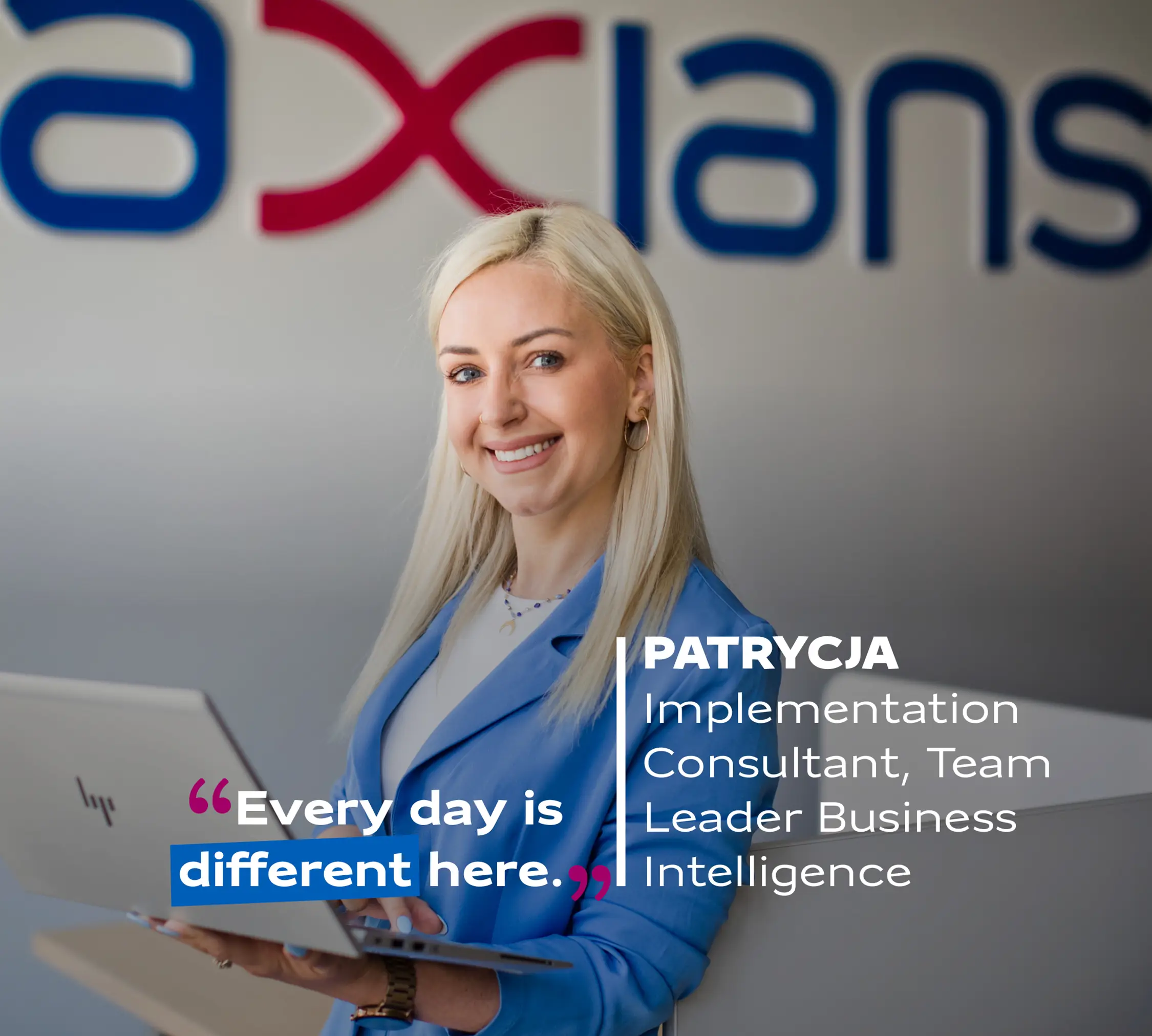

Of course. My name is Patrycja Kwinta, and I’m an Implementation Consultant and Team Leader of the Business Intelligence team. My responsibilities include managing a team that currently consists of four people. Apart from management duties, I’m still an Implementation Consultant, which means I implement business applications and various Business Intelligence solutions for our clients.
This includes working with products from companies like Infor, IBM, and Microsoft, particularly Power BI. It’s a broad toolkit, but the main focus of my work revolves around Business Intelligence—creating reports, business models, financial controlling solutions, and tools for forecasting and budgeting.
Absolutely. It’s a very exciting field. On the one hand, it’s tied to the IT industry, but on the other hand, it doesn’t have overly demanding technical requirements, making the entry threshold lower than for programmers who need years of specialized training. In reality, every company needs Business Intelligence solutions, regardless of the industry or scale of operations.
Every organization generates data and wants to analyze it. Our role is to help achieve that goal in the most optimal, efficient, and accessible way possible.
Let’s start from the beginning. I’m a mathematician by education, and from the start, I wanted to work as a data analyst. That was my primary goal after graduating, and I spent many years working as a data analyst in large organizations. I’ve worked in industries like sales, banking, and even in a very large state-owned manufacturing company—a refinery. This gave me extensive experience with analyzing data using foundational tools.
Over time, I felt the need to do more. What I was doing seemed insufficient, and I believed there were better ways to approach these tasks. I reached a point where I had to choose a direction: Did I want to focus on preparing reports, or did I want to analyze existing ones to uncover the reasons behind specific results? For me, the answer was straightforward.
I was working in the refinery, and the oil industry required deep market analysis, which wasn’t my strong suit. I’m not particularly interested in political topics or analyzing the impact of decisions like why the President of the United States made a certain statement and how it might influence oil prices. That wasn’t the path for me. Instead, I started focusing on creating useful reports, dashboards, and automation solutions.
I dislike repetitive tasks and didn’t want to come to work every day to do the same things. Unfortunately, much of an analyst’s job involves that kind of routine—preparing the same reports in the same way and analyzing the results. To break away from that, I began automating those repetitive processes myself, using tools like Power BI. Over about six months, I built a set of Business Intelligence models that streamlined my workflows. The next six months were spent convincing management and my supervisors that these solutions were beneficial and worth adopting. Once I succeeded, I realized I had outgrown my role in that company.
That’s when I came across a job posting at S&T (now Axians). It caught my attention, even though I wasn’t entirely sure what the role of an Implementation Consultant entailed.
To sum up, I initially steered myself toward Business Intelligence and later found the opportunity at S&T, where I’ve stayed and grown—now at Axians. Here, my career has taken off significantly, and I’ve learned to work with a variety of tools.
It was a promotion, which happened last year. I didn’t expect it at all. To be honest, I never envisioned myself on this career path, so it was quite a surprise. Generally, I like to plan my career moves and know what I want to achieve, but this came out of the blue. I decided to give it a try, see how it goes, and I have to say, I’m really enjoying it so far. It’s challenging, requiring a lot of self-reflection and personal growth, but it’s also very rewarding. The role is vastly different from my previous work, as I now spend much more time working with people rather than just numbers. That’s a significant shift, but it’s been a positive one.
For me, after years of working in various corporations, the most important aspect is the atmosphere. It’s crucial to work with people you like, respect, and who respect you in return. Both sides should feel supported.
While there are individual tasks to handle, the nature of implementation work often brings up challenges—whether they’re client-related or technical. At Axians, I’ve always felt that I can rely on my colleagues. If one person encounters a problem, it’s easy to find help, whether it’s about technical issues, implementation challenges, or even team leadership concerns. When I unexpectedly became a Team Leader, many people at Axians offered guidance and support. For me, the people you work with are the foundation of a great company culture.
It’s hard to describe a “typical” day because every day is different. Everything depends on the projects we’re working on, and since each project and client is unique, we adapt accordingly.
That said, we do have some regular practices. For instance, we hold team meetings to discuss progress and challenges. I try to keep these meetings relaxed and focused on problem-solving rather than strict reporting. They’re a space for open discussion and brainstorming.
We also have a fun tradition in our team—“Meme Fridays.” We have a dedicated channel on Teams where everyone shares memes to lighten the mood and foster camaraderie. It’s a great way to maintain team spirit, especially since some of us work from the Kraków office while others are remote in Gdańsk.
Additionally, I prioritize one-on-one conversations with my team members. These aren’t formal meetings but casual check-ins. They know they can always come to me, and I make an effort to get to know them personally. Work is about tasks and results, but building a good atmosphere is equally important to me. Knowing what’s going on in my team members’ lives helps foster trust and understanding.
The biggest challenge for me was becoming a Team Leader. It was a completely new experience, especially transitioning from being a team member to managing the same team. It required a lot of self-reflection and growth.
Giving positive feedback has always come naturally to me. I frequently thank my team members, acknowledge their contributions, and write back promptly when they send me completed tasks. I know from personal experience how much these gestures matter. However, I’ve had to work on managing my emotions. I’m a very expressive person, sometimes prone to panic, but as a Team Leader, I’ve learned that every emotion can impact the entire team. I’ve been focusing on communicating information rather than emotions, and that’s been one of my biggest challenges.
One of the most significant milestones was my first project, which was for a leading bank in the country. It was my first major project, so it felt like my baby. Although it was stressful at times, I poured my heart into it, and the collaboration with one of the clients was so intense that we even became friends. That project was a major turning point for me.
I want to continue developing my managerial skills. I’m looking forward to training programs that will help with that. I also want to grow my team, both by nurturing the potential of my current team members and by bringing in more experienced colleagues to strengthen our capabilities.
My advice would be to approach your tasks with dedication and courage. Treat others the way you’d like to be treated. Mutual respect and collaboration are key to success. Also, keep an open mind to new tools and ideas. The world is evolving rapidly, and staying adaptable is crucial.
Thank you. The pleasure was all mine.